7 Stunning Châteaux in France You Won’t Want to Miss During December
Out of all the châteaux I’ve been to at Christmas, Chenonceau is my favorite. I think part of it is the story behind it, having been known as Le Château des Dames (Ladies’ Castle). It sits across the River Cher in the Loire Valley, and is the stuff fairytales were made of. Kings and queens fought over it, Diane de Poitiers claimed it as her jewel, and Catherine de Medici swept in and made it hers, adding the long gallery that sits in all its splendor over the water.
If Chenonceau is the elegant lady of the Loire, Amboise is the château that feels closest to the heart of French history. Perched high above the town, it looks out over the Loire River, its towers and walls telling stories of kings and court life. The town of Amboise is lovely too and worth exploring.
Azay-le-Rideau is smaller than the great royal châteaux, but it has a beauty that lingers with you. Built on an island in the River Indre, the Renaissance turrets and slate roofs reflect in the water so perfectly that it feels like the whole château is floating. It was started in the early 1500s by Gilles Berthelot, a wealthy financier, and finished by his wife, Philippe Lesbahy, after he fled into exile.
Chinon is different from the polished Renaissance châteaux of the Loire. It is a fortress first and foremost, built high above the Vienne River, its long stone walls stretching across the ridge. This is where Joan of Arc came in 1429 to meet Charles VII and convince him she was sent by God to lead his army. It’s where kings plotted, prisoners languished, and centuries of war left their mark.
Villandry has always been about its gardens. Built in the early 1500s and later reimagined by Joachim Carvallo and his wife in the 20th century, the château became a living textbook of Renaissance design. Terraces spill down toward the River Cher, laid out in intricate patterns of vegetables, herbs, and flowers. Even in winter, when the leaves are gone, the bones of the gardens remain, all lines, geometry, and clipped boxwood.
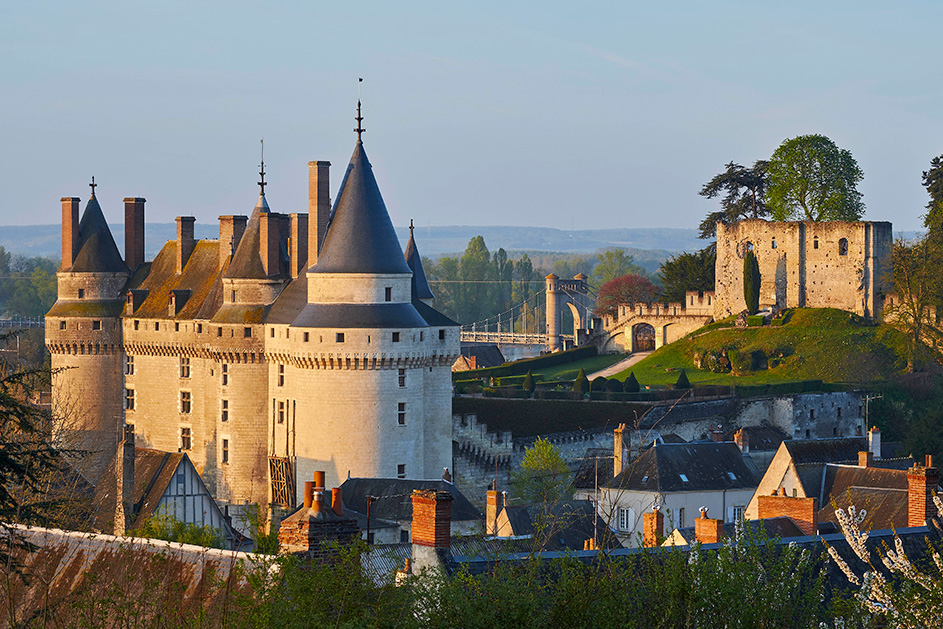
Langeais sits between Tours and Saumur, right on the edge of the Loire, its stone towers rising directly from the town’s main square. On December 6, 1491, King Charles VIII married Anne of Brittany in the Great Hall, an event that sealed Brittany’s union with France forever.
Loches began as a frontline fortress in the struggle between Anjou and Blois. Foulques Nerra, Count of Anjou, built the massive keep between 1013 and 1035, which set the tone for everything that followed.